Alexander III of Macedon, the red-headed warmonger who carved an empire from northern Greece to what is now Pakistan, spent nearly half his life on battlefields. He embodied the ancient mantra of "live fast, die young," yet history has largely sanitized his image, crowning him "the Great." But peel back the layers of legend and you find a man far more complex, contradictory, and frankly, unhinged than the sanitized textbooks dare to admit. Was he a military genius, a visionary leader, or merely a brilliant, booze-fueled megalomaniac with a knack for self-promotion and a penchant for extreme violence? The truth, as always, is far nuttier.
The Bloody Ascent: Parricide, Purges, and Power Plays
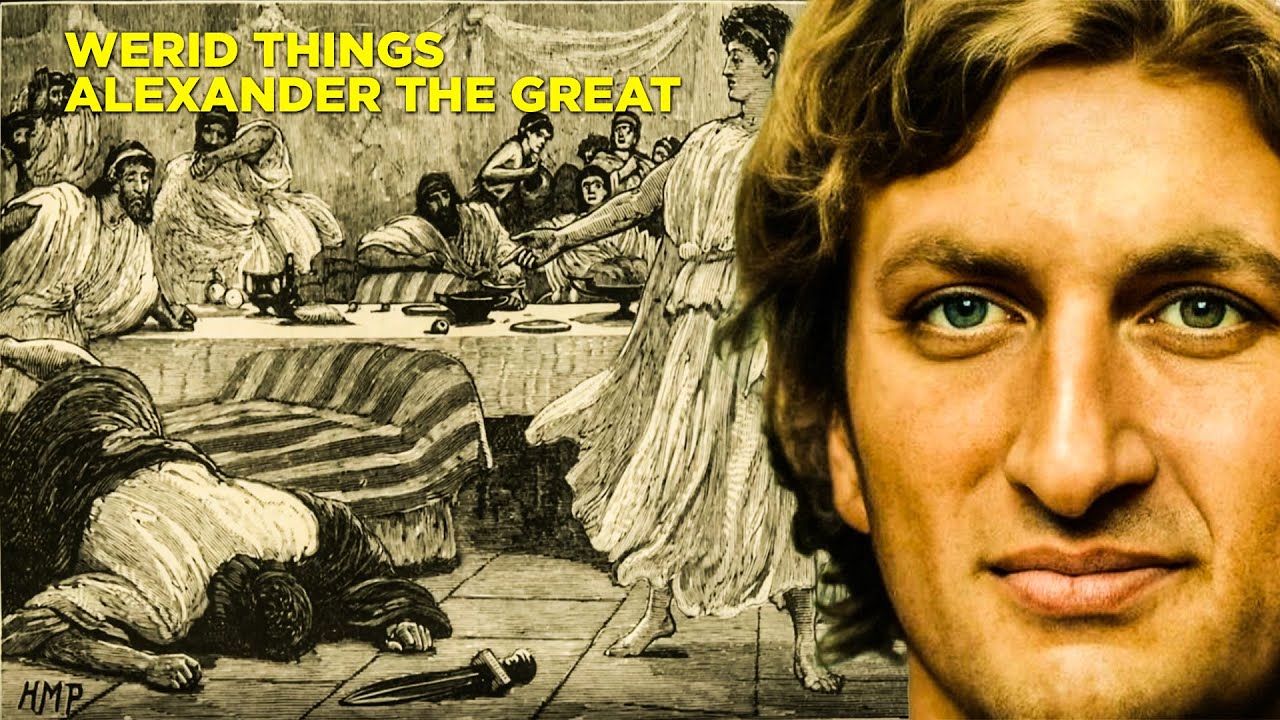
The stage for Alexander's rise was set with one of ancient history's most compelling assassinations: that of his father, Philip II of Macedon. In 336 BCE, Philip, then 47 years old and walking with a limp from an old battle wound, made his entrance into the theater of Aegae. Pausanias, one of his bodyguards, lunged forward, a dagger concealed beneath his cloak, and impaled the monarch to death. Pausanias attempted to flee but tripped on a vine root before reaching his horse, and Philip's loyalists swiftly cut him down.
The official narrative suggested Pausanias acted alone, fueled by a personal grudge. He had indeed been one of Philip's former lovers, but as the king aged, his affections shifted to younger men. Philip made Pausanias his bodyguard, a position that, in a cruel twist, forced him to witness Philip's romantic entanglements up close. This perceived betrayal and humiliation, a simmering resentment, was certainly motive enough for murder. But was it enough to fell a king as formidable as Philip, a man who had rescued Macedon from oblivion and forged it into a power strong enough to conquer a fractured Greece? A king's assassination, especially one of Philip's caliber, usually required more than just personal vendetta; it required motivation at a higher level. And this is where his son Alexander and Alexander's mother, Olympias, enter the picture.
There's no smoking gun, no concrete evidence proving Olympias, and perhaps Alexander, directly orchestrated Philip's demise. Yet, the efficiency with which they consolidated power in the immediate aftermath is remarkably suspicious. Olympias, conveniently, wasn't even in Macedon when the assassination occurred. This suggests either an uncanny foresight into the unfolding events or an unparalleled gift for contingency planning. Alexander was already designated by Philip as regent during his incursions in Asia Minor, giving him a legitimate claim. But the subsequent purge was brutal and effective. Olympias ensured Philip's new wife, Cleopatra Eurydice, and her infant son, Alexander's half-brother, were swiftly eliminated, removing potential rivals to the throne. Antipater, one of Philip's senior officers and close to Alexander, persuaded the Macedonian assembly to proclaim Alexander king. The timing was impeccable, as two other powerful generals, Attalus (misidentified as Adolescens in the transcript, but contextually Attalus) and Parmenion, were away from Pella on campaign. When news reached them, Parmenion, proving his loyalty to the new king, executed Attalus for voicing opposition to Alexander's ascension. In the cutthroat world of ancient succession, Alexander and Olympias played the game with ruthless, almost Godfather-level, precision.
The Philosopher King: Aristotle's Pupil with a Nerds Club
Despite the brutality of his ascent, Alexander was no mere brute. Unlike his father, he wasn't a pure Macedonian; his mother, Olympias, was the daughter of Neoptolemus, King of Epirus, giving him Greek blood. This heritage was one reason many in the Macedonian court initially opposed his claim. Macedonians were often looked down upon by the more "civilized" Greeks, a perception Philip sought to change, partly by giving his son an unconventional education. Alexander showed early signs of being a prodigy, an intellectual who could hold his own in discussions with adults. He reportedly read all of Greek literature before puberty and held the poet Homer as his hero, rather than any other warriors or kings, save his father.
At the tender age of 14, Alexander was sent to a private academy established by the famed philosopher Aristotle at Mieza, several miles from the royal court at Pella. For three years, under Aristotle's tutelage, he immersed himself in poetry, philosophy, and literature. This intellectual foundation never left him. The historian Plutarch notes that Alexander carried a copy of The Iliad, among other books, with him throughout his campaigns, using them to inform his strategic and decisive approach. He even maintained a "nerds club," a whole court of philosophers, scientists, and history writers who accompanied him on his martial campaigns. He would engage them in discussions, keeping his mind sharp between battles. One might even speculate, with a touch of irreverence, that if Dungeons and Dragons or Warhammer had existed in antiquity, Alexander might have found a less bloody outlet for his strategic brilliance, sparing countless lives in the process.
He reportedly read all of Greek literature before puberty and held the poet Homer as his hero, rather than any other warriors or kings, save his father.
The Drunken Despot: Wine, Rage, and Regret
Yet, the intellectual brilliance of Alexander was often overshadowed by a darker side: that of an insecure megalomaniac and a heavy drinker, a truly volatile combination. Despite his legendary status, Alexander was, by many accounts, a hardcore frat boy at heart, infamous for his inability to hold his liquor. Standing a relatively diminutive five feet two inches tall, he was known for throwing extravagant parties filled with "intercourse fervor" and copious amounts of fermented beverages. He would get so profoundly drunk that the healers in his camp considered his liquor problem a major potential cause of his eventual death, even suggesting it might have made him vulnerable to poisoning.
Macedonians, unlike their Greek neighbors, were known to drink their wine undiluted, a practice Alexander embraced with disastrous consequences. His addiction, perhaps a coping mechanism fueled by intense parental expectations, manifested in terrifying ways. The destruction of Persepolis, the jewel of the Persian Empire, stands as a stark testament to his drunken rage. After defeating Emperor Darius III, Alexander and his men celebrated with a grand banquet. Plutarch recounts that Ptolemy's mistress, Thais, reminded a heavily intoxicated Alexander of how the Persians had desecrated the Acropolis in Athens a century prior. Despite Parmenion's pleas to reconsider such a drastic decision under the influence of alcohol, Alexander, being Alexander, ordered his men to pillage and burn the city to the ground. When he left, Persepolis, once among the world's most impressive cities, was a ruin, its site known for generations only as "the place of the 40 columns" for the remaining palace columns left standing. Alexander later regretted his decision, but clearly, he didn't learn his lesson, as just four years later, he would tragically kill his dear friend Cleitus the Black in a drunken quarrel.
Another grim example of his alcohol-fueled recklessness occurred at Susa. After his close advisor, the philosopher Callinus, immolated himself to avoid a slow death from old age and disease, Alexander, struck with grief, organized a drinking competition to honor his friend. This was a terrible idea. Forty-one contenders, including soldiers and locals, participated. The rules were simple: whoever drank the most unmixed wine won a crown worth a talent of gold. The victor, a foot soldier named Promachus, managed to consume an astonishing four gallons of the potent, undiluted wine. Predictably, he perished soon after. Only five others died on the spot, but ultimately, not a single contestant survived the ordeal. Alexander himself would succumb to wine just a year later. His paranoia and megalomania only fueled his addiction, leading him to consume vast quantities of alcohol even after fever had struck him in his final days. He would insist on more wine instead of water, convinced his fever was merely an acute case of alcohol withdrawal.
The First Spin Doctor: Making Greece Great Again
Alexander the Great, for all his military prowess, possessed a political acumen that would be unsettlingly familiar in the modern world. He could check every box on the list of a successful, albeit ruthless, contemporary politician. Inheriting his father's plans to confront the Persian Empire, Alexander vastly expanded the scope, dreaming not just of Asia Minor but of conquering the entire Persian realm. To achieve such an ambitious goal, he needed the backing of all Greece. And to secure that, he resorted to sophisticated propaganda.
Relations between Persia and Greece had largely stabilized by Alexander's time, but he expertly reopened the wounds of the Persian War, a conflict that had occurred a century earlier. When Thebes dared to obstruct his plans, he made an example of it, annihilating the city. However, ever the shrewd strategist, he knew he couldn't replicate this brutality across all of Greece without losing vital support. Instead, Alexander framed his campaign against the Achaemenid Empire as a patriotic retaliation for Persia's failed invasion of the Greek mainland, essentially a "making Greece great again" narrative. He projected Macedonians as the saviors of Greek pride, falsely claiming his armies were invading Persia on behalf of all Greeks and therefore required their unwavering support. It's worth noting, of course, that Macedon had not been involved in the Greco-Persian Wars and had not supported the Greek cause back then, making his claims a spectacular act of historical revisionism.
His propaganda machine didn't stop there. He masterfully leveraged the legend of the Gordian Knot. According to prophecy, any man who could unravel the intricate knot, tied to an ox cart in the Phrygian capital of Gordium, was destined to become ruler of all Asia. When Alexander arrived, he tried and failed to untie it. Reasoning that it didn't matter how the knot was loosened, he drew his sword and famously sliced it in half with a single stroke. His followers immediately spread the narrative that he had fulfilled the prophecy, further promoting his image as Greece's destined savior. His officers began addressing him as "Lord of Asia." Alexander also believed he was a direct descendant of the mythical hero Achilles, a belief his mother, Olympias, actively encouraged, even telling him that Zeus, not Philip, was his true father. If that wasn't enough to fuel a god complex, an oracle at Siwa in Egypt later "confirmed" Zeus as his biological father, a clear act of appeasement to the conqueror. Alexander was also a master of false promises. When his army mutinied at the Hyphasis River, demanding to go home, Alexander agreed. But secretly, he was planning to invade Arabia on his return journey, a plan likely only thwarted by his untimely death.
He projected Macedonians as the saviors of Greek pride, falsely claiming his armies were invading Persia on behalf of all Greeks and therefore required their unwavering support.
The Ultimate Culture Vulture: 70 Cities and a Horse Named Bucephalus
After the PR disaster at Persepolis, Alexander demonstrated another facet of his political genius: cultural appropriation. To rectify his image in Persia, he engaged in a series of stunts to project himself as "one of them." This was the same man who had used Greek patriotism to invade Persia. To the dismay of cultural purists back in Macedon and Greece, Alexander began wearing Persian royal dresses, imitating their customs, and even forcing his men to take Persian women as wives. He replicated this strategy in Egypt and Bactria as well, seamlessly adopting local customs to solidify his rule and present himself as a legitimate successor rather than a foreign conqueror.
But perhaps the clearest indicator of his colossal ego was his unabashed narcissism. Do we even need to mention that he named an astounding 70 cities after himself? Beyond the famous Alexandria at the mouth of the Nile in Egypt, other Alexandrias can be traced across present-day Turkey, Iran, Afghanistan, Tajikistan, and Pakistan. After defeating King Porus near the Hydaspes River, he founded the city of Bucephala, named for his beloved horse. While not named after himself, it still speaks volumes about a man who felt the need to immortalize his possessions and achievements on the map of a conquered world. He was, in essence, the ultimate culture vulture, bending traditions and geography to his will, all in service of his own legend.
The Nutty History of Alexander
Alexander the Great, then, was no simple hero. He was a complex, contradictory figure: an intellectual prodigy and a ruthless killer, a charismatic leader and a drunken tyrant, a master strategist and a megalomaniac obsessed with his own divine lineage. His story is a potent reminder that history, far from being a dry collection of dates and names, is a vibrant, often shocking tapestry woven from ambition, genius, vice, and sheer, unadulterated human weirdness. The textbooks may remember him as "the Great," but Nutty History reminds us that he was also just plain nutty.