Forget everything your grade school textbooks told you about Christopher Columbus "discovering" America in 1492. That narrative is a polite fiction, a convenient whitewashing of a far more complex and frankly, nuttier, historical reality. Long before Columbus even dreamed of sailing the ocean blue, a different set of Europeans, the Vikings, had already set foot on North American soil. Their sagas tell of mysterious lands, foreign tribes, and encounters that were anything but peaceful, painting a picture of exploration, conflict, and ultimately, a mysterious retreat that left behind tantalizing clues and a legacy of "what ifs."
The Red-Haired Exile and the Greenwashed Land
Our story begins not in North America itself, but with a man named Eric the Red, a figure whose temperament was as fiery as his hair. Around 980 AD, Eric found himself banished from Iceland for a rather significant indiscretion: he had eliminated someone. Faced with a three-year exile, Eric set sail westward, exploring a vast, icy land he then audaciously named "Greenland." His choice of moniker was a brilliant piece of ancient marketing, designed to entice settlers to this rather cold and inhospitable piece of real estate. And it worked. Thousands of Vikings, seeking new opportunities or perhaps just a fresh start, ended up settling there, establishing a thriving, if harsh, community.
It was from Greenland that whispers of even more distant lands began to circulate. A merchant sailor, blown dramatically off course on his journey from Iceland to Greenland, returned with tales of an unknown territory to the west. Eric's son, Leif Erikson, a man evidently possessing his father's adventurous spirit but perhaps a touch more diplomacy, was captivated by these stories. Around 1000 AD, Leif organized an expedition, setting sail with a crew of 35 men to verify the existence of this rumored new world. They found it, establishing a temporary camp in what is now widely believed to be Newfoundland.
During this initial, brief sojourn, the sagas recount an interesting detail: Leif's foster father, a man named Tyker, supposedly became quite tipsy on "wineberries." Historians speculate these could have been fermented cranberries, gooseberries, or squash berries, all native to the region. Leif and his crew did not linger long, returning to Greenland without any recorded encounters with the indigenous peoples of the mainland. However, it is thought that the Norse Greenlanders had already met some Native Americans, or at least their ancestors, on Greenland itself, engaging in trade with the Thule people, the ancestors of the Inuit.
First Blood, Furs, and the "Dried Skin" People
The interactions between the Norse and the indigenous peoples, whom the Vikings termed "Skraelings," were complex and often fraught. Evidence suggests early trade, with ivory carvings of Norsemen found at Thule archaeological sites, alongside iron and bronze tools that the Thule were incapable of manufacturing themselves. The origin of the term "Skraelings" itself is telling, thought to derive from the Old Norse word "Scruff," meaning "dried skin," likely a reference to the animal pelts worn by the Inuit ancestors. These early, perhaps peaceful, contacts would soon give way to outright hostility.
A few years after Leif's uneventful return, his brother, Thorvald Erikson, embarked on a second voyage to the new world. Thorvald and his men established themselves at the very camp Leif had abandoned. When spring arrived, the Vikings stumbled upon a group of nine natives sleeping beneath skin-covered canoes. In a move that would set a grim precedent for future European encounters, the Vikings attacked them, killing all but one. The sole survivor escaped, returning with reinforcements, and a battle ensued. Thorvald Erikson, the aggressor, met his end in this skirmish, struck down by an arrow. Despite this tense and ultimately fatal encounter, the remaining Vikings incredibly stayed another winter before returning to Greenland, perhaps a testament to their stubbornness or the sheer difficulty of the return journey.
The origin of the term "Skraelings" itself is telling, thought to derive from the Old Norse word "Scruff," meaning "dried skin," likely a reference to the animal pelts worn by the Inuit ancestors.
The Grand Expedition and a Bullish Betrayal
The allure of these new lands persisted, even after Thorvald's demise. Several years later, a more ambitious expedition was mounted by Thorfinn Karlsefni, a wealthy merchant of distinguished lineage. Thorfinn organized a far grander undertaking than either of the Erickson brothers, commanding three ships and a contingent of between 160 to 250 men and women, along with livestock, signalling a serious intent to settle. His group ventured farther south than previous expeditions, eventually establishing a base in a place they called Straumsfjord.

Here, they again encountered the Skraelings. Initially, relations were surprisingly peaceful. The two groups engaged in extensive bartering, with the Native Americans eagerly trading furs for red cloth and a wondrous, unfamiliar liquid: milk, which came from the cattle the Vikings had brought over. This fragile peace, however, was living on a knife's edge. Instances of hostility and outright fighting became more frequent, slowly eroding the trust between the two cultures.
The breaking point, according to one account, was remarkably mundane: a bull from the Viking camp got loose and frightened a group of Native Americans. The incident, seemingly minor, escalated rapidly. The frightened natives fled, but returned in greater numbers, ready for battle. They attacked the Vikings, employing a weapon previously unknown to the Norse: catapults. A legendary battle followed, but the writing was on the wall. This confrontation proved to be the final straw for Thorfinn and his prospective colony. They abandoned Straumsfjord and returned to Greenland, effectively ending the Viking attempt at large-scale settlement in North America for hundreds of years. No European would attempt to settle in the new world again until Columbus's era.
Unearthing the Ghost Settlements: L'Anse aux Meadows
For centuries, the tales of Vinland were relegated to the realm of myth and legend, dismissed by many as fanciful sagas. However, in the 1960s, a Norwegian couple, Helge Ingstad and Anne Stine Ingstad, embarked on a determined quest, scouring the northeastern Canadian coast for archaeological evidence that could corroborate the sagas. On the northern tip of Newfoundland, they found it: L'Anse aux Meadows.
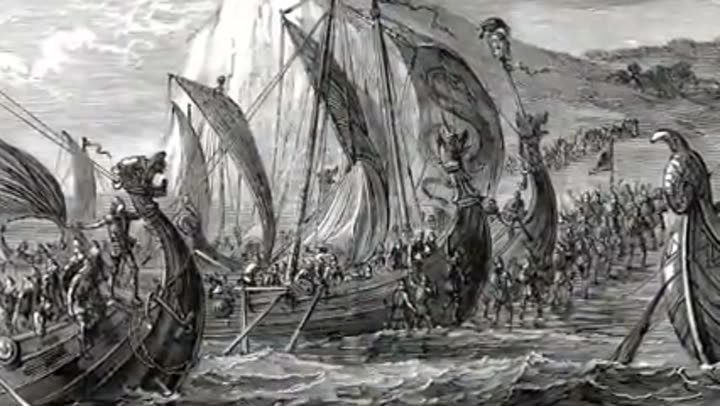
This site stands as the only confirmed Viking settlement in North America. The archaeological findings were unequivocal, providing concrete proof of Norse presence. Excavations revealed the remains of eight sod houses, clearly constructed in the Viking style. Crucially, evidence of iron work was discovered, a technology beyond the capabilities of the indigenous peoples of the time. A boat-building frame also pointed to sophisticated maritime activities. Experts believe L'Anse aux Meadows might have served as a ship repair center, strategically located for voyages across the North Atlantic to Greenland. A small but incredibly significant artifact solidified the identification: a bronze pin with a ring at the end, likely used to fasten a cloak. Identical pins have been found at various Viking archaeological sites in Scotland and Ireland, all dated to between 920 and 1050 AD, perfectly aligning with the saga timelines.
The Coin That Crossed the Ocean and the Skeptic's Shadow
While L'Anse aux Meadows provided irrefutable proof of a settlement, another fascinating piece of evidence surfaced further south, adding to the intrigue. In August of 1957, on a beach in Brooklyn, Maine, an amateur archaeologist named Guy Mellgren made a curious discovery: an old coin. Initially, he suspected it was a medieval British penny. However, in 1978, experts conclusively identified it as a Norse coin, minted between 1065 and 1093 AD. The site where the Goddard coin was found is also notable for containing a large number of arrowheads, leading some to speculate that the arrival of the coin might have coincided with the introduction of archery among the Native Americans in the region. Did ancient Viking visitors share this technology?
The Norse coin, unlike L'Anse aux Meadows, initially faced significant skepticism from historians and archaeologists. This caution was not unfounded; previous claims of Viking discovery in America had been marred by hoaxes, most notably the infamous Vinland Map and the fabricated Kensington Runestone found in Minnesota. However, the Goddard coin has withstood intense scrutiny by experts, who agree on its authenticity. It bore all the wear and tear expected of a coin buried for centuries, lending credence to its narrative as a genuine artifact of Norse-Native American contact.
The site where the Goddard coin was found is also notable for containing a large number of arrowheads, leading some to speculate that the arrival of the coin might have coincided with the introduction of archery among the Native Americans in the region. Did ancient Viking visitors share this technology?
Sagas, Speculation, and Shifting Shores
Much of what we know about these Viking expeditions to the new world comes from two primary written sources, collectively known as the Vinland Sagas: The Saga of Eric the Red and The Saga of the Greenlanders. These sagas, though written down a couple of hundred years after the events they describe around 1000 AD, largely recount the same basic stories of Norse settlements in North America. While they differ in some details, they provide the narrative backbone for our understanding of these voyages.
The sagas mention three main geographical areas: Heluland, Markland, and Vinland. Heluland, described as the farthest north, meaning "land of flat stones," is speculated by some to be Baffin Island in Canada's northern territory of Nunavut. South of Heluland was Markland, or "land of forest," which many hypothesize corresponds to Labrador. The southernmost and most fabled land was Vinland, or "land of wine," generally thought to be modern-day Newfoundland. The exact locations remain a subject of fervent debate, fueled by the sagas' evocative but often vague descriptions of the landscape.
Another persistent mystery surrounds the precise location of Thorfinn Karlsefni's camp, Straumsfjord. The sagas describe it as having strong currents and high tides, a bay that offered a natural harbor, craggy rocks in the distance, and a winter where the sun rose by mid-morning and set in mid-afternoon. Furthermore, it was teeming with so many nesting birds that it was difficult not to step on their eggs. Various places along the northern coast of North America have been proposed as Straumsfjord, from the Bay of Fundy and L'Anse aux Meadows in Canada, to Buzzards Bay in Massachusetts, and even as far south as the Long Island Sound in New York. Each theory attempts to reconcile the saga's descriptions with modern geographical features, highlighting the ongoing challenge of mapping legend to reality.
Why Didn't They Stay? The Climate's Cruel Hand
The ultimate mystery, perhaps, is why these fierce Viking warriors, renowned for their resilience and expansionist drive, failed to establish a lasting presence in North America. Why did they not set down roots, and why does a significant portion of North America's population not speak Norse today? Speculation abounds: perhaps they simply did not bring enough people or supplies for sustainable colonization. Or perhaps, as Thorvald and Thorfinn's expeditions suggest, the hostile encounters with the indigenous peoples proved too formidable to overcome.

However, one of the leading theories points to a far more powerful, uncontrollable force: the climate. The 11th century, when Leif Erikson, Thorvald Erikson, and Thorfinn Karlsefni led their expeditions, coincided with a period known as the Medieval Warming Period. During this time, the climate was notably warmer, characterized by hotter summers and significantly less Arctic sea ice, which would have made sea routes more accessible. But this climatic benevolence was fleeting. Starting in the 12th century, the Earth entered what is now known as the Little Ice Age. Temperatures began to drop dramatically, and sea ice accumulated, rendering many of the crucial sea routes impassable. This dramatic shift made life in Greenland and Iceland increasingly difficult for the Norse settlers. Evidence points to widespread food shortages and devastating plagues. For example, between 1250 and 1700, Iceland's population plummeted from an estimated 150,000 to just 50,000, a stark illustration of the harsh realities faced by these northern settlements.
The Viking stint in North America was, in the grand scheme of history, incredibly brief. What we know of it has been filtered through centuries of oral tradition, eventually committed to sagas that blend historical fact with mythological fiction. The physical evidence, though compelling, amounts to a single confirmed settlement, a small bronze pin, and a solitary coin. Yet, the tantalizing question remains: what if they had stayed? What if the climate had not turned, or if their encounters with the Skraelings had been more amicable? The course of North American history, and indeed global history, would have been irrevocably altered.
The story of the Vikings in North America is a potent reminder that history is rarely as neat and tidy as our textbooks suggest. It's a messy, brutal, and utterly fascinating tapestry woven with ambition, violence, trade, and the unforgiving hand of nature. The past, it turns out, was always far nuttier, filthier, and weirder than we were ever taught in school.