Modern parents might fret over confiscating a PlayStation or deleting a TikTok account, imagining their child's world ending. But rewind a few centuries, and the consequences for breaking society's rules, or simply falling afoul of power, were less about digital deprivation and more about unimaginable physical torment. From ancient empires to the Spanish Inquisition, humanity has displayed a shocking ingenuity for inflicting pain, devising methods that make a modern prison cell look like a five-star resort. Forget what the sanitized textbooks told you; history's darker chapters reveal a world where punishment was an art form, perfected with chilling precision.
Public Declarations of Pain
Long before cities dotted the landscape, a brutal form of capital punishment known as impalement was already a favored tool of terror. A long, sharp, and often greased stake would be employed, either longitudinally or transversely, and the victim left exposed, frequently outside city walls, to instill fear in passersby. The Assyrians, particularly Emperor Ashurbanipal, were masters of this macabre art in antiquity. Later, in the late Middle Ages, Vlad the Impaler, Prince of Wallachia, earned his fearsome moniker with pride. For longitudinal impalement, the stake was inserted between the prisoner's legs while elevated, with gravity ensuring the spike would slowly traverse the body, carefully avoiding major organs like the heart, lungs, and spleen. It would eventually exit through the shoulder, neck, or, for the truly unlucky, the lower part of the skull. A person could endure this agonizing process for
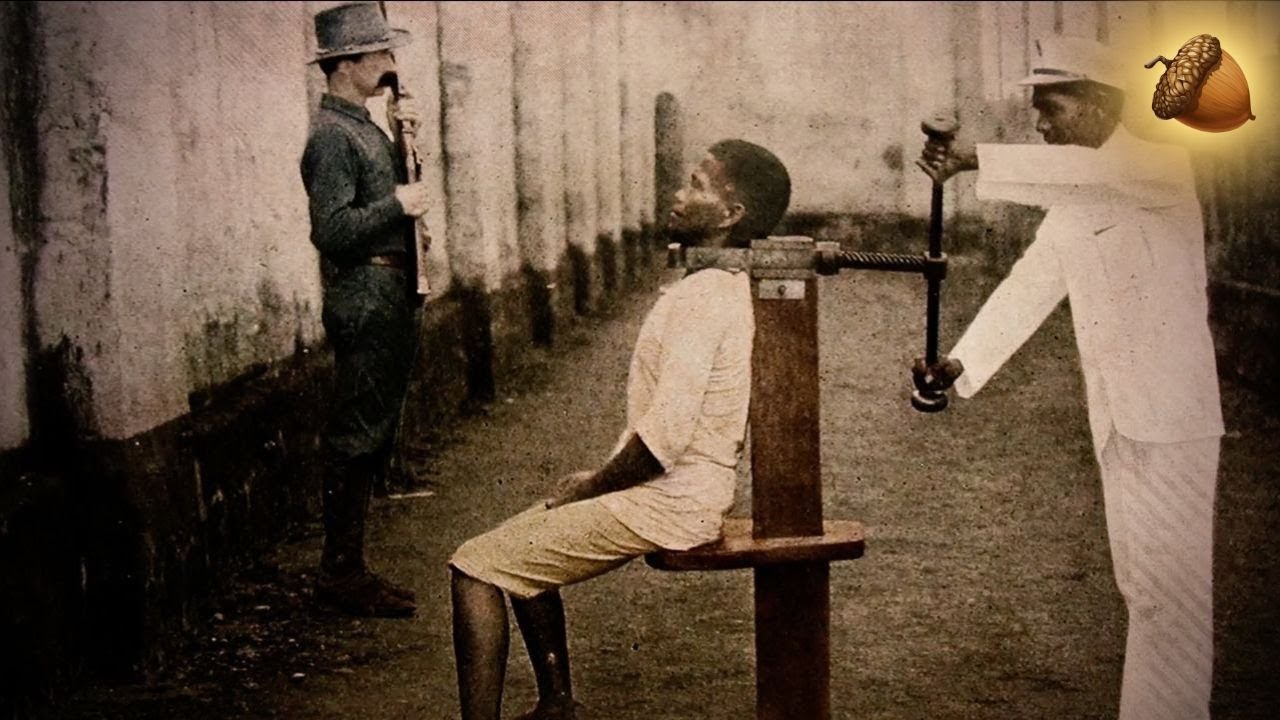
The garrote, a method used for hundreds of years in Spain, offered a different, yet equally horrifying, path to death. The prisoner would be seated on a small, chair-like structure, their neck pushed into a hole on an upright pole. A rope, looped around the neck, was then tightened by twisting a stick, slowly strangling the victim. This device, believed to have been invented by the Romans in the 1st Century BCE to punish conspirators of the Second Cataline Conspiracy, spread through Spain and Portugal during the Dark Ages, was used by the Spanish Inquisition, and brought to the Americas by the Conquistadors. It famously ended the life of the Inca Emperor Atahualpa. King Ferdinand VII cemented its status in 1813, making it the exclusive standard form of the death penalty, replacing crude hangings that often prolonged suffering. Surprisingly, Napoleon introduced a version of the garrote to Spain during the Napoleonic Wars of 1808 to 1814, using it to quash Spanish guerillas and anyone inspiring uprisings against the French invaders. Records, though patchy, indicate that at least
Another medieval public spectacle was the wheel, also known as the Catherine wheel or breaking wheel. While its origins are unclear, the earliest record dates to the 6th Century CE from the author Gregory of Tours. This punishment traveled widely, documented in Austria, Britain, France, Germany, Rome, the Ottoman Empire, Russia, Sweden, and even the Indian subcontinent. There was no standardized application: it could involve being trampled by a moving wheel or, more commonly, being tied to cross beams while executioners systematically broke bones, starting with the legs, using clubs or the wheel itself. A Jewish man named Jonah endured this torment for
Crucifixion, a punishment that later became the holy symbol of the world's most popular religion, predates its most famous victim by millennia. Possibly invented by the Assyrians, it spread to Babylon, Phoenicia, Macedonia, and eventually ancient Rome. The practice involved tying or nailing a prisoner to a wooden beam or cross. Nails were typically pierced just underneath the wrist, not through the palm, to ensure the body could be supported without tearing through the flesh. This placement impaled bones, causing immense anguish, but avoided major blood vessels, preventing rapid death from bleeding or shock. It also caused fingers to seize and hands to go numb, preventing escape attempts. The feet, nailed to the vertical beam, would slowly bleed, forcing the body's weight onto the arms and shoulders. This constant strain would pull shoulders out of their sockets, eventually leading to the body's full weight resting on the chest, making every breath a struggle, and ultimately resulting in suffocation. Modern incidents of crucifixion have occurred as recently as
Emperor Nero, a man whose mental health remains a subject of historical debate, invented another truly dark art: the Roman Candle. Like crucifixion victims, prisoners were tied and nailed to tall stakes. A flammable liquid was then poured over them, followed by other materials designed to slow the burning process. When lit, they would burn for hours, like a candle. Nero would light these human torches in his garden, using them to illuminate his lavish feasts and celebrations, the fire starting at the feet and slowly reaching vital organs.
The Art of Extraction: Torture for Truth (or Lies)
In medieval times, public knuckle cracking might have been considered rude, but the rack offered a far more aggressive form of joint manipulation. Invented by the Duke of Exeter in 1420, this device stretched prisoners beyond their body's limits until their joints audibly popped. The primary objective was to extract confessions and incriminating information from suspected traitors, heretics, and conspirators. The prisoner was laid on a wooden frame, limbs tied to rollers at either end. As the rollers turned, they would pull the prisoner's joints apart, resulting in bones popping, joints ripping, and tendons coming undone. Anne Askew, a 16th-century English writer and devout Protestant, faced this torment. Charged with heresy under King Henry VIII, she was racked for information about other women in her social circle who shared her beliefs. Despite the excruciating pain, she refused to divulge names. She was taken off the rack, paralyzed, and then burned at the stake. England continued to use the rack well into the 17th century, with Guy Fawkes being one of its most famous victims.

A particularly grim incident saw 80 Freemasons garroted in 1935 alone in Malaga for refusing to abandon their religion to join the armed forces.
The Judas Cradle, a crude early modern invention by Hippolytus de Marcelus in the 16th century, was another device designed for prolonged agony and confession. This pyramid-shaped wooden device forced the prisoner to sit on its sharp tip. To intensify the pain, their legs would be tied together, and sometimes weights were added to their bodies. Most victims of the Judas Cradle were religiously persecuted individuals, charged with heresy or belonging to Protestant, Islamist, or Jewish faiths.
The iron chair was a dreaded fixture in medieval dungeons. Accusations of direct involvement in murder, witchcraft, adultery, or banditry could earn someone a seat on this infernal device. The victim's legs and wrists would be shackled, and a fire lit beneath the chair, slowly roasting them alive. In other variations, the fire was placed at a distance, and the chair was gradually pushed towards the flames. After a few decades, between 500 and 1500, spikes were added to the back, seat, armrests, and leg rests, perhaps to ensure the chair was sufficiently sadistic.
The Spanish Donkey, also known as the
The Pear of Anguish, also known as the choke pear or mouth pear, likely originated in the 16th or 17th century. This pear-shaped device with a bulbous head was inserted, not into the mouth as the name might suggest, but into other orifices, most notoriously the rectum. A screw on the device's other side was turned to expand the bulb inside the prisoner, primarily to extract information or force a confession. The sheer pressure and threat of ripping delicate tissue were often enough to compel prisoners to agree to whatever was demanded of them.
Finally, the Heretic's Fork, a brutal medieval device in use from the 11th to the 16th centuries, offered a different form of persuasive agony. It consisted of a leather belt snugly attached to the neck, with two sharp prongs: one for the chin and one for the sternum. This device forced the wearer to maintain a steady, upright head position. Any movement would cause the prongs to dig in, causing excruciating pain. Prisoners might throw their heads back, hoping to maintain that posture for hours, or lash out in an attempt to end their lives quickly. However, the prongs were designed to make such attempts only prolong the agony. The device was used both for extracting confessions and for silencing prisoners, ensuring they spoke no more than their prosecutors desired.
Rats, Pits, and Pests: The Vermin of Vengeance
Rats, those persistent followers of humanity, were not always merely exterminated or domesticated; sometimes, they were weaponized. Roman Emperor Nero, whose mental state is often questioned by historians, was an early pioneer in using these rodents for justice. He would have the mouth of a bucket filled with starving rats tied to a prisoner's stomach, then apply heat to the bottom of the bucket. Hungry and burning, the desperate rats would claw and chew through whatever was in their path to escape the heat. Centuries later, medieval Germany upgraded this torment, replacing the bucket with a metal cage featuring a pocket for hot charcoals at the bottom, designed to prolong the anticipation, anxiety, and torment, thereby ensuring a desired confession. Drawing from this same concept, medieval Germany also introduced the rat chair, where a prisoner was forced to sit upright with a metal cage teeming with hungry rats strapped around their face instead of their belly.
During Elizabethan times, the rat dungeons beneath the Tower of London gained infamy, striking dread into the hearts of Catholics living in the city. Prisoners led into these dark, subterranean cells would hear the screams of others and the scurrying of rats approaching from the River Thames as the tide flowed in. Things reached a new level in 20th-century South America, where rats became popular among dictators. Castello Branco, who ruled Brazil from 1964 to 1985, the five dictators of Uruguay from 1973 to 1986, and General Jorge Rafael Videla in Argentina from 1976 to 1983, all employed rat-based tortures. But the most horrifying account comes from Augusto Pinochet, who ruled Chile from 1973 to 1990 and created the punishment called the
Records, though patchy, indicate that at least 736 people were garroted during the 19th century, including 16 women.
If you thought rats were bad, consider scaphism, or 'the boats,' an ancient Persian punishment so innovative it would make hell's administrators proud. According to the Greek historian Plutarch, this was the worst form of punishment he witnessed. A prisoner, like the unfortunate Mithradates, would be placed between two floating boats, with their head and limbs sticking out, but their body trapped inside. They would then be force-fed copious amounts of milk and honey until visibly bloated, and then even more. Their body and face would also be plastered with honey. Left alone, the prisoner would attract vermin and bugs. The excessive milk and honey would induce severe diarrhea, enticing more pests not only to join the feast but often to enter the victim's body and eat them inside out. This horrific procedure would be repeated for
Oubliettes were solitary confinement dungeons designed to make prisoners, literally, forgotten. These canonical or cylindrical pits, built within castles or fortresses during the Middle Ages and used until the 18th century, were intended to dispose of prisoners of war and criminals so they would never again see the light of day. Leap Castle in Ireland, a site of generational feuds between the O'Bannon and O'Carrolls clans, held a particularly grim secret. In the 1920s, its oubliettes were discovered
Beneath the Waves and Beyond the Skin
Keelhauling, a naval punishment most likely popularized by the Royal Dutch Navy in the 15th or 16th century, though also used by the English Navy since the 11th century and possibly originating with the ancient Greeks in the 9th century BCE, was a truly horrific ordeal. The offending sailor would be stripped, tied, and suspended by a rope from the ship's mast, often with weights or chains attached to their legs. The rope was then looped beneath the ship, and the sailor dragged under the keel from one side to the other. The chances of surviving this ordeal were absolutely zero. Most sailors would drown, but if by some miracle they survived the initial dunking, severe head trauma from repeatedly smacking against the keel would finish the job. For the time they were alive, they would suffer deep lacerations from barnacles and other aquatic life growing on the hull. Even if they made it back on board, infections from these wounds would ensure death was not far behind.
Flaying, or skinning, has existed since humans first began warring and punishing lawbreakers, becoming a popular method in medieval Europe. The victim would be stripped and their limbs tied to prevent resistance. The executioner would use a knife to peel the skin, often starting with the head to inflict the maximum pain before the victim lost consciousness from blood loss. Persian King Cambyses II took this even further: he flayed his judge Sisam for corruption, then used Sisam's skin to make a chair for the judge replacing him, Sisam's own son, as a constant reminder of his father's fate. Another unfortunate victim of flaying was Hypatia of Alexandria, a brilliant mathematician and astronomer, who was an innocent victim of a religious mob.
Ancient Rome, a society that prided itself on hierarchical and patriarchal family structures, considered parricide the most heinous crime. For this, they devised
The Cruel Spectacle of the Gibbet
While most torments aimed to make the punishment worse than death, gibbeting extended beyond it. Gibbeting involved extremely cramped, straightjacket-like cages, often custom-made by blacksmiths who had to reinvent the wheel each time. These cages were then hung from a pole at a considerable height from the ground. Gibbeting attracted large, enthusiastic crowds, sometimes numbering in the
One major reason for its discontinuation, apart from the terrible fate of the prisoner, was the stench. While intended as a crowd attraction, the gibbets made living nearby absolutely horrendous and a health hazard. They were hung as high as
The Iron Maiden: Myth and Misdirection
Few medieval torment devices capture the popular imagination quite like the Iron Maiden, yet its historical reality is far more elusive than its pop culture presence suggests. This infamous metal casket, often depicted towering nearly
The earliest known account comes from the historian Johann Philipp Siebenkees, who, in a 1793 guidebook to Nuremberg, cited the use of an Iron Maiden in 1515. He claimed the spikes were deliberately kept small enough to prolong the prisoner's life, causing them to bleed slowly for
Humiliation as a Weapon
If a man in Athens around 500 BCE was caught committing adultery or an unprovoked carnal aggression, he might find himself subjected to a grim legal punishment known as
For centuries, rural Britain played host to a bizarre form of community punishment known as Riding the Stang in the north of England and Scotland, and Skimmington Riding in parts of Southern England. Both versions involved a boisterous rabble of villagers taunting and embarrassing an offender with an elaborate parade. Typically, when a husband was found to have used violent methods on his wife, the young men of the village would organize a procession. A "stang," which was a hurdle or pole, would carry a village jester or an effigy of the offender through the streets. Pots and pans were banged, whistles and horns blown, and all the villagers would join in the cacophony. The procession would usually move around the village before arriving at the home of the transgressor, who would presumably be peeking nervously through the curtains. On some occasions, the actual offender was paraded around. Some of the last recorded instances of Riding the Stang occurred as recently as
The comfortable narratives of school history often gloss over the sheer, visceral brutality of human justice systems, leaving us with a sanitized, palatable version of the past. But peel back the layers, and you find a world where innovation wasn't just for building pyramids or philosophical treatises, but for devising increasingly elaborate and excruciating ways to control, punish, and deter. These aren't just morbid curiosities; they are stark reminders that the human capacity for cruelty, and the desperate search for order, has always been far, far nuttier than any textbook dares to admit.