The American Civil War, often lionized in our history books for its grand strategists and heroic sacrifices, hides a darker, more infuriating truth. Beneath the veneer of noble causes and battlefield glory, an astonishing parade of blunders, arrogance, and sheer incompetence turned the conflict into an unimaginable charnel house. Forget the statues and the stirring speeches for a moment, and consider a Union general so paralytically drunk he tumbled from his horse before a single shot was fired, or an entire army ordered to march a mile across open ground into a hail of cannon fire, with half never returning. These were not random acts of fate; they were the direct consequences of monumental idiocy, decisions that bled armies dry and prolonged a war that cost over 600,000 lives.
The Autocrat Who Ate His Own Army
When Jefferson Davis, a West Point graduate, Mexican-American War veteran, and former US Secretary of War, assumed the presidency of the Confederacy, his pedigree suggested competence. Yet, this self-proclaimed master of military affairs proved to be one of the war's most spectacular failures, primarily because he possessed zero grasp of supply chains. The irony was palpable: a rebellion built on states' rights found itself led by an autocrat who centralized command with a fervor that would make any European monarch blush. Davis feuded with his most capable generals, like Bogard, and consistently ignored urgent pleas from state governments for food and clothing. This was the leader of a fledgling nation with a population of just 9 million, nearly half enslaved, and a fraction of the North's industrial might; northern industry, for perspective, produced about 97 percent of all firearms in America.
Davis's obsession with control left his armies starving in the field. At Vicksburg in 1863, besieged Confederate troops were reduced to eating rats and mules, with some grim reports alleging men boiled shoe leather to survive. The Confederate treasury confirmed that by 1864, inflation had reached a staggering 9,000 percent, rendering basic goods impossible to afford for the common soldier and citizen alike. Instead of fostering cooperation, Davis's heavy-handed approach alienated state governors, who, furious that he had trampled the very autonomy they had seceded to protect, hoarded their supplies. The president of a rebellion against central authority was sabotaging his own allies.
Davis, it seemed, learned nothing from his mistakes. Hemmed in by shortages that made victory nearly impossible, he repeated the same micromanaging playbook year after year. When his strategies inevitably failed, this Confederate ignoramus blamed his generals, never his own poor judgment. Believing that discipline alone could win the war, he allegedly interfered in petty assignments, sacked officers who disagreed, and ignored audits that clearly showed supplies rotting in depots. The ultimate irony was that Davis himself was ruined by the very rigidity he championed. His last disaster unfolded in 1864 and 1865, as Confederate armies crumbled across every front. After three years of barely gaining ground, they lost Atlanta, the Shenandoah Valley, and the Carolinas in a matter of months. As the lines collapsed, Davis fled south from Richmond, still demanding that his starving men stand firm. Desertion soared, with some estimates claiming over 100,000 soldiers simply walked away rather than serve a cause that could not feed them. Captured in April 1865 in Georgia, his reign of micromanaged failure came to an end. While some argue his centralization was necessary to hold fractious states together, in practice, his style starved the front lines without creating unity, breeding resentment faster than loyalty, and ultimately collapsing the Confederacy from within.
Picnics and Panic: The First Bull Run Fiasco
If Davis starved his armies from the top, our next fool starved them of something even more fatal: discipline. On July 21, 1861, Union General Irvin McDowell led the Army of Northeastern Virginia into its first major test of the war. Fort Sumter had fallen just three months prior, and the pressure from Washington was deafening. The Union needed a quick victory, a decisive blow to prove the rebellion could be stamped out in 90 days. "On to Richmond!" shouted the newspapers, and the crowds believed it.
McDowell, however, was a reluctant commander. A respected logistics officer, meticulous with supply lines, he possessed little battlefield experience and harbored no illusions about his army. He warned Lincoln and the cabinet that his men were untrained, that they needed months of drilling. His pleas were ignored. Political enthusiasm had overruled military caution. The plan was deceptively simple: march south with 35,000 volunteers, cross Bull Run Creek, overwhelm the Confederates, and continue down the road to Richmond. In theory, it would end the war before it truly began. In practice, it was chaos. The army consisted of 90-day volunteers, armed but barely drilled. The march itself was delayed by poor scouting and logistical bottlenecks. McDowell attempted to maneuver around the Confederate left, but the complexity of the plan far outstripped the discipline of the troops ordered to carry it out.
At first, the offensive seemed promising. Union brigades crossed the creek and pushed Confederate defenders back. For a fleeting moment, victory seemed within reach. But by midday, reinforcements arrived under General Thomas Jackson, who held firm on Henry House Hill, earning his legendary nickname "Stonewall." Union attacks faltered, and McDowell hesitated, watching momentum slip away. Then, the route began. Civilians from Washington, having brought picnic baskets and carriages to watch the glorious Union triumph, instead witnessed disaster unfold before their eyes. As a Confederate counterattack stiffened, McDowell's volunteers broke. Soldiers abandoned wagons, threw down muskets, and streamed back toward the capital in panic. The very spectators who had come to witness glory were caught in the crush, their carriages blocking the roads, their picnic baskets trampled in the mud. It was a scene of utter humiliation.
The receipts were damning. Union reports indicated 2,900 men lost in the battle, compared to about 1,750 Confederate casualties. While not catastrophic in raw numbers, the symbolic devastation was immense. The South was emboldened, and the Union was forced to reckon with the stark reality that this war would be neither quick nor easy. McDowell himself had begged for more training, and militia parades before the battle had already shown how unsteady his troops were. Yet, political pressure forced him into the field, compelling him to execute a plan he knew was fatally flawed. His idiocy lay in assuming that enthusiasm equaled readiness, a survivorship bias that convinced him and his superiors that zeal alone could carry men through a campaign. Instead, it prolonged the war, giving the Confederacy its first major morale victory. The total casualties reached 4,700, and the defeat hardened Confederate resolve, extending the conflict by years and costing hundreds of thousands of lives.
The Perfectionist's Paralysis: McClellan's Slow Burn
If McDowell froze when the moment came, our next general went the other way, waiting so long for perfect conditions that victory slipped through his fingers. Before disaster tarnished his image forever, Union General George B. McClellan was celebrated as "the Young Napoleon," admired for his brilliance in organization and training. The man who could turn raw recruits into a polished army, however, carried a fatal flaw: he chronically overestimated his enemies, often by a factor of two to one. He was, according to Lincoln himself, "a man with the slows," a drill master who dazzled on paper but stumbled when decisive action was required.
In 1862, McClellan unveiled his great design, the Peninsula Campaign. For months, he drilled and delayed, convinced that only perfect conditions could guarantee success. Even while commanding more than 100,000 men, he famously wrote in frustration, "I need more men." This fixation on numbers became his mantra, a blind spot that paralyzed his ability to strike.
Imagine finding your enemy's entire playbook and still refusing to win. Any aggressive general would have crushed Lee's divided army on the spot. Instead, McClellan hesitated.
Then came Antietam. In September, Union soldiers stumbled upon a miracle: Robert E. Lee's lost Special Order 191, laying out Confederate troop positions. Imagine finding your enemy's entire playbook and still refusing to win. Any aggressive general would have crushed Lee's divided army on the spot. Instead, McClellan hesitated. On September 17, 1862, he deployed his troops gradually, holding back reserves while the battle raged. As men died in the cornfields and the sunken road ran red, the largest Union force ever assembled waited idle. Even with his opponent's plans in hand, McClellan delayed.
The receipts were damning. Lincoln's letters seized on McClellan's "mispursuit" as having cost the Union a decisive victory. Union intelligence made clear the Confederates were far weaker than McClellan imagined. Still, he clung to inflated estimates and refused to press the attack. Warnings were everywhere; scouts returned with reports disproving his fears, and Lincoln sent direct orders to move forward. But McClellan ignored them, convinced that the enemy was stronger and that his army was not ready. This paralysis by analysis turned advantage into a stalemate. Metrics of readiness replaced momentum, and the promise of victory dissolved. The damage was immense. Antietam became the bloodiest single day in American history, with 23,000 casualties. Instead of crushing Lee, McClellan allowed him to slip back into Virginia, prolonging the war by more than two years. To his credit, McClellan built the Army of the Potomac into a disciplined and professional force, instilling order where chaos had reigned. But his hesitation gave the Confederacy time to regroup, bleeding both North and South without delivering the victory that was within his grasp.
The Gambler's Ruin: Hood's Reckless Wager
The Civil War had no shortage of blunderers, but our next commander risked everything like a reckless gambler at the table. John Bell Hood was once regarded as one of Robert E. Lee's fiercest young commanders, earning rapid promotion after leading his Texans with undeniable courage. But by 1864, the man once known for bold charges had been shattered physically, losing the use of an arm at Gettysburg and a leg at Chickamauga. Elevated into high command, with his body broken and his judgment clouded, Hood became the Confederacy's most dangerous liability.
When Hood took command of the Army of Tennessee in July 1864, he promised what Joseph E. Johnston could not: aggression. Johnston had frustrated Richmond by retreating before Sherman's advance on Atlanta. Hood, eager to prove himself, launched repeated assaults that failed to stop Sherman and instead drained his army. But the real disaster was still coming: an order so suicidal that even his own men could not believe it. By September, Atlanta had fallen, a loss that guaranteed Lincoln's re-election and dealt the Confederacy a crushing political and military blow. Losing Atlanta was catastrophic, but Hood pressed on, convinced that a march into Tennessee would draw Sherman back north. He ignored the reality that Sherman had no intention of following him. Instead, Sherman continued his campaign in Georgia while Union General George H. Thomas prepared to block Hood.
In September 1864, at the Battle of Franklin, Hood ordered a direct assault against entrenched Union lines at dusk, across nearly two miles of open ground. His men attacked without adequate artillery preparation and suffered one of the war's worst disasters. In just five hours, more than 6,000 Confederates were killed, wounded, or missing, including six generals killed and eight others wounded or captured. Franklin left the Army of Tennessee crippled, but Hood refused to stop. He advanced to Nashville, where his force was outnumbered two to one in freezing conditions. Over two days in December, George Thomas struck Hood's army with repeated flank attacks. Thomas used essentially the same maneuver on both days, and Hood's army broke under the pressure. The Army of Tennessee ceased to exist as an effective fighting force, suffering thousands more casualties and desertions. To his credit, Hood once inspired troops through his personal bravery, fighting at the front until his crippling wounds made that impossible. But as an army commander, his reckless decisions cost the Confederacy its last major field force in the West.
A Mile of Fire: Lee's Folly at Gettysburg
Hood's disaster at Franklin set the stage for another grand plan, one where Robert E. Lee ordered a charge that would doom his army at Gettysburg. On July 3, 1863, at Gettysburg, Lee believed he saw the moment to break the Union line. He ordered what became the most infamous "Hold My Beer" charge in American history, Pickett's Charge. While the plan bore the name of Major General George Pickett, overall command rested with Lee and his corps commander, James Longstreet. It was supposed to be the bold stroke that cracked the Union center. Instead, it became the high-water mark of the Confederacy, a phrase that meant only that things would never go so well for the South again.
The idea was deceptively simple: three divisions, Pickett's Virginians, Pettigrew's North Carolinians, and Trimble's men, would march across nearly a mile of open ground and smash through the Union line at Cemetery Ridge. Lee convinced himself that after two days of fighting, Union morale was shaken and that the center was vulnerable. Believing this, he did not prepare his men with alternatives or ensure his artillery could properly support the attack. What Lee did not realize was that the Confederate bombardment had largely failed. Many shells overshot the Union position, while Union Chief of Artillery Henry Hunt deliberately ordered his batteries to slacken fire, tricking Colonel Edward Porter Alexander into believing Union guns had been silenced. Longstreet, who opposed the assault from the beginning, later said he could only nod when Pickett asked if he should advance. Warnings were given, but they were ignored. Some officers argued the ground was impossible to cross. Longstreet himself told Lee that "no 15,000 men ever arrayed for battle can take that position." Yet Lee pressed ahead, convinced that one more push would bring victory.
At about 2 p.m., roughly 12,500 Confederate soldiers advanced from Seminary Ridge. The heat was stifling, the ground open, and Union artillery quickly poured fire into their ranks. Fences along the Emmitsburg Road slowed the march, leaving men exposed to shot and shell. Thousands never advanced beyond the road, with many forced to shelter in its shallow depression instead of moving forward. On the Confederate left, Pettigrew's men were torn apart by musket fire from the 8th Ohio and Union batteries. On the right, Pickett's Virginians pressed on into a storm of canister and musketry. A small group under General Lewis Armistead broke through the stone wall at the angle, briefly piercing the Union line. Armistead fell mortally wounded, and with no reserves to support the breach, the attack disintegrated. Within an hour, the charge collapsed into retreat.
The results were staggering. Of the 12,500 Confederates who advanced, more than half became casualties, around 6,500 killed, wounded, or captured. Every brigade commander in Pickett's division was killed or wounded. One Union officer remembered the scene: "Arms, heads, blankets, guns, and knapsacks were thrown and tossed into the clear air. A moan went up from the field." To be fair, the men who marched showed extraordinary discipline and courage under impossible conditions. But no amount of bravery could overcome entrenched rifles and cannon across open ground. Lee's folly, born of a romanticized belief in one last push, cost him the war's high-water mark.
The Butcher of Fredericksburg: Burnside's Bloated Blunder
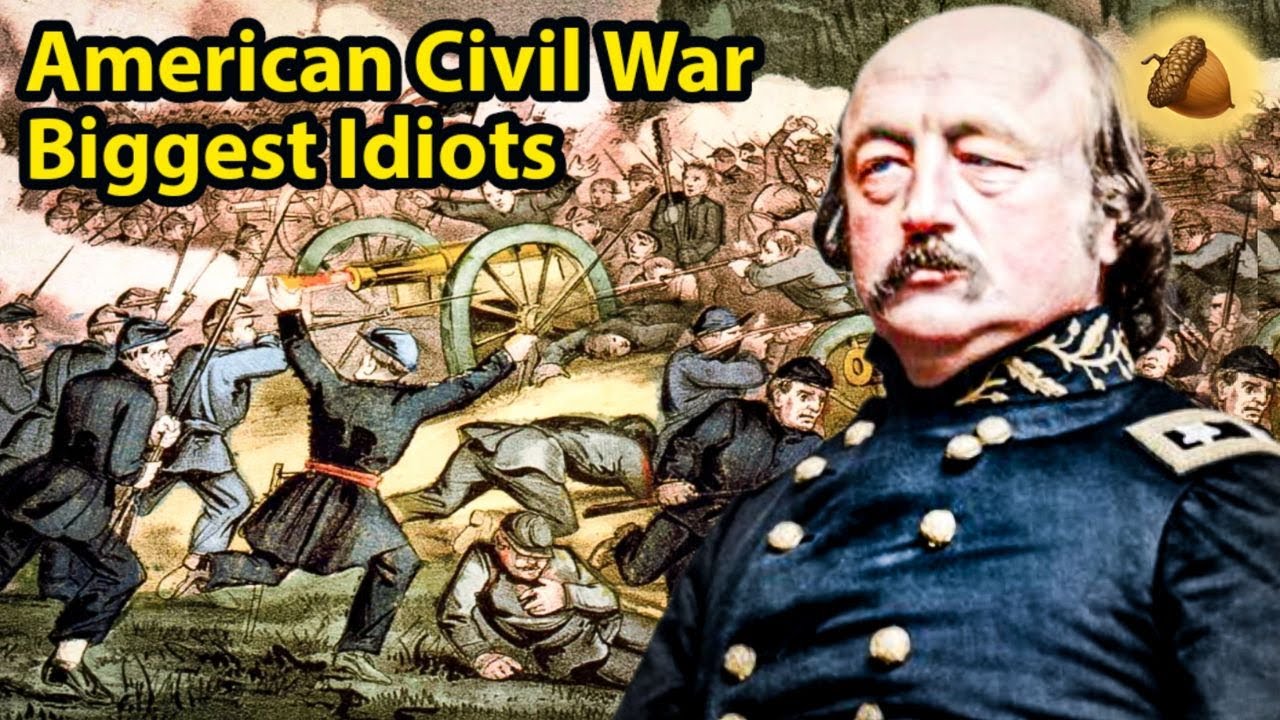
If Pickett's folly marked the Confederacy's high-water mark, then Ambrose Burnside's actions marked a new low for Union strategic thinking. The man at the center of this disaster was Major General Ambrose Burnside, a general absolutely unsuited to high command. Using his connections to President Abraham Lincoln, who had just removed George McClellan after Antietam, Burnside was promoted to lead the Union Army of the Potomac in November 1862. He inherited about 118,000 men, the largest army on the continent, significantly outnumbering Robert E. Lee's roughly 78,000 Confederates. So, what did Burnside do with this massive advantage? He marched on Fredericksburg, where in December he launched one of the most lopsided failures of the entire war.
Burnside's guiding idea was to act quickly, even when timing and logistics were against him. And they were certainly against him, because the pontoon bridges needed to cross the Rappahannock River arrived weeks late due to bureaucratic and supply delays. During that time, Lee entrenched his army on the heights behind Fredericksburg. By the time the Union Army attempted to cross, about 40,000 Confederates were positioned along a stone wall at Marye's Heights, backed by more than 50 artillery pieces. One Confederate officer remarked, "A chicken could not live on that field when we open on it." The definition of insanity is doing the same thing over and over again and expecting different results. This could easily apply to stupidity as well, because Burnside ordered repeated assaults across 900 yards of open ground, uphill, against entrenched cannon and rifles.
On December 13, 1862, Union losses totaled about 12,600 compared to fewer than 5,000 Confederate casualties. Roughly 8,000 of those Union casualties came from the futile charges at Marye's Heights. Not a single soldier broke the Confederate line there.
In total, 13 separate charges were made in front of Marye's Heights. The Irish Brigade, for example, sent about 1,200 men forward; the next day, only 256 were able to report for duty. Eyewitnesses described survivors clinging to the coats of fresh regiments, pleading with them not to advance. The irony was that Burnside's disaster was compounded by poor communication. On the Union left, Major General George Meade briefly broke through Stonewall Jackson's position at Prospect Hill. But vague orders and a lack of coordination meant the success went unsupported. Burnside, believing the main fight was at Marye's Heights, kept funneling brigades into the killing ground rather than exploiting the breakthrough. By nightfall, thousands of Union dead and wounded carpeted the slope, and the Confederates still held the wall.
The receipts were staggering. On December 13, 1862, Union losses totaled about 12,600 compared to fewer than 5,000 Confederate casualties. Roughly 8,000 of those Union casualties came from the futile charges at Marye's Heights. Not a single soldier broke the Confederate line there. To be fair, Burnside believed he had to move before winter shut down campaigning. Lincoln and General-in-Chief Henry Halleck also pressed him to act, warning him against hesitation. But the rebuttal is plain: by mistaking speed for strategy, Burnside converted opportunity into slaughter. Bayonets, as he so grimly proved, do not beat stone walls.
Vultures on the Homefront: Profiteers and Copperheads
If Burnside proved bayonets do not beat stone walls, the profiteers proved greed could gut a nation faster than any cannon. What do you think of when you hear the word "Copperhead"? If it makes you picture snakes waiting in the grass, striking unseen, then you are close to the mark. During the Civil War, "Copperhead" was a nickname for Northern Democrats who opposed Lincoln and the war effort, often undermining morale on the homefront. Alongside them were profiteers, contractors, and speculators who treated the conflict not as a national struggle, but as a chance to make fast money. The corruption was blatant.
Union soldiers at the front begged for equipment, but some contractors delivered uniforms made from cheap rags that fell apart in the rain and boots that disintegrated after a march through mud. The word "shoddy" entered the English language because of these worthless goods. Meanwhile, speculators hoarded flour, salt, and fuel, forcing prices higher while families at home tightened belts and soldiers went without. And then came the Copperheads. Ohio's Clement Vallandigham thundered that Lincoln was a tyrant and the war a wicked crusade. Their speeches and pamphlets encouraged draft resistance. In 1863, Congress rolled out the first federal draft, but with a fatal loophole: for $300, roughly a year's wage for a laborer, the wealthy could buy exemptions, leaving the poor to carry the burden. The result was fury.
In July 1863, New York erupted in the Draft Riots. For four days, the streets ran wild, leaving at least 120 people dead and millions in property destroyed. The ugliest scenes were directed at black New Yorkers, who were lynched in broad daylight by mobs looking for someone to blame. It remains one of the worst episodes of racial violence in American history. Instead of rallying unity, the draft revealed a truth as brutal as any battlefield charge: when incentives favor greed over equity, legitimacy collapses into violence. The receipts were undeniable: at the same time Union armies fought at Gettysburg and Vicksburg, profiteers lined their pockets while Copperheads weakened the cause from within. Poor laborers saw the rich escape service by paying $300 for substitutes, roughly a year's wages for a working man. The result was fury, resentment, and blood in the streets. To be fair, not every critic of Lincoln wanted a Southern victory, and profiteering is a constant companion of war. But in a moment that demanded immense sacrifice, these individuals acted like parasites, feeding on a body already bled white.
The American Civil War, a conflict that saw over 620,000 people die, was not merely a clash of ideologies or a test of wills. It was also a testament to the profound and often catastrophic impact of human error, arrogance, and outright idiocy. From micromanaging presidents who starved their own armies to generals who gambled away entire corps, from political blunders that sparked riots to profiteers who clothed soldiers in rags, the war's true horror lies not just in the bullets and bayonets, but in the sheer scale of the avoidable suffering caused by those in charge. History, as it turns out, is far nuttier, filthier, and weirder than any textbook dare to admit, and sometimes the most dangerous men aren't the villains, but simply the fools with power.