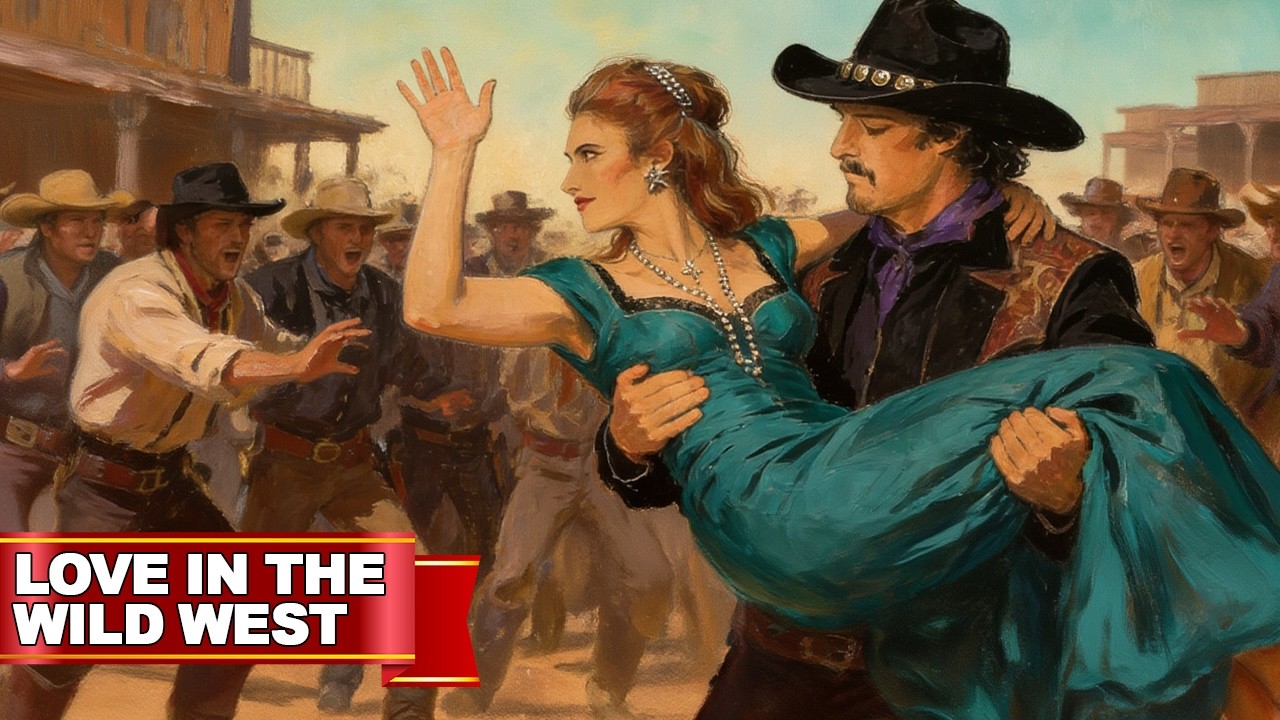
Imagine a place where the ratio of men to women was so wildly skewed that a lawyer in San Francisco in 1849 could write home, describing how if a woman merely appeared on the street, all men would stop, stand, and stare. The mud in those nascent streets was so deep, he noted, that the latest fashion was for men to carry women in their arms. This wasn't some outlandish fantasy, but the lived reality of the American West, a raw, untamed land that utterly defied the prim and proper Victorian sensibilities of love and marriage then emerging in England. Forget everything school taught you about romance, because on the frontier, love stories were forged in a crucible of desperation, independence, and sheer logistical impossibility.
The Great Imbalance: A Land Starved for Women
The Wild West, that vast, untamed expanse, truly earned its moniker after the American Civil War. Its legends were carved from a hard, rugged existence, where the lines of morality blurred and gunslingers often wrote the law. This era, stretching from the Gold Rush through the Oregon Trail, the Louisiana Purchase, and the Mexican War, culminated in a seismic shift with the Homestead Act of 1862. This legislation, ironically the brainchild of Abraham Lincoln, promised 160 acres of land to any white settler who could build a home on it. For Native Americans and people of color, however, the promise of liberty and land ownership was, predictably, a cruel mirage.
The Homestead Act, coupled with the Pacific Railway Act, unleashed a torrent of migration. The government sweetened the deal for railway construction, offering a staggering $16,000 in government bonds for every 10 square miles of transcontinental track laid, a sum equivalent to roughly $5 million today. This economic incentive, combined with the lure of free land, sent men flocking westward. But there was a critical, immediate problem: these men needed families, or at the very least, wives, to establish a successful homestead. Imagine these rough-hewn pioneers, having spent months, if not years, without female companionship, perhaps looking and smelling as wild as the land itself. Convincing a woman to marry them was a monumental task.
The numbers tell a stark story. San Francisco in 1849, for instance, boasted a population of 20,000. Of that number, a mere 1,000 were women. And out of those 1,000, fewer than 400 were not actively working in or managing a brothel. This severe gender disparity meant that women held an unprecedented power, a stark contrast to their constrained roles in more settled parts of the world. Men, often desperate, saw beauty in every woman, a sentiment vividly captured by a Sacramento woman who confided in her diary, "Even I have had men come 40 miles over the mountains just to look at me and I was never called a handsome woman in the best day even by most art admirers." The frontier, it seems, was a place where conventional beauty standards took a backseat to sheer availability.
The Unconventional Path: Women Forging Their Own Fortunes
While men charged west driven by gold and land, women migrated at a far slower pace, and for very different reasons. Society at large didn't exactly encourage women to strike out on their own. Those who did were often driven by a fierce desire for economic independence, a yearning for control over their own destinies that was largely unattainable elsewhere. Many found themselves in saloons, which frequently doubled as brothels, a difficult but often economically viable path. Others, particularly younger women, saw opportunity in education. Bright, capable women, some as young as 15 or 16, migrated to fill teaching vacancies.
These young teachers often lodged with the families of their pupils, rotating homes to ensure their safety and protect them from the "characters of bad faith" that roamed the frontier. Yet, even this seemingly secure arrangement carried its own risks and dramas. Consider Glendelene Kimmel, a teacher in southern Wyoming at the turn of the 20th century. While lodging with the Miller family, she stumbled upon their plan to settle a land dispute with their neighbors, the Nicholls, with guns. She confided this information to her secret boyfriend, Tom Horn. Days later, Horn was convicted and subsequently hanged for the murder of 14-year-old Willie Nickel. The West, even for those in respectable professions, was a volatile place where personal relationships could have deadly consequences.
Beyond the immediate dangers, women faced societal pressures that followed them even to the frontier. Some cities, like San Francisco, imposed rules requiring female teachers to quit their jobs upon marriage. This forced many women to confront a stark choice: independence or matrimony. The sheer scarcity of women, however, inadvertently empowered them. Some of the most successful and influential women in mid-19th century America thrived on the frontier, where they were vastly outnumbered by men and subject to a raw, unfiltered form of masculinity that paradoxically granted them more agency than their Eastern counterparts. They understood that to survive, and to find the man of their dreams, they often had to take charge of their own lives, pushing against traditional Victorian norms.
Courting in the Crucible: Rules of Engagement on the Frontier
For all the wildness of the West, traditional courtship still held sway for many. Most women, particularly those from more conservative families, would not consider courting without the express permission of the man of the house: her father, or in his absence, her brother, or failing that, her uncle. A suitor was expected to declare his intentions from the outset, promising marriage and assuring the family of his honorable intentions. Only if the patriarch approved would the courting phase begin, a process far removed from modern dating.
Saloons, for instance, were generally off-limits for women from respectable families. Instead, acceptable activities included walks, horseback riding, and picnics, which were, surprisingly, all the rage. Men often developed a particular fondness for women who could ride a horse with skill and grace, a practical asset on the frontier, yet still maintain an air of feminine charm, much like a scene from a classic Western film. Beyond outdoor pursuits, courtship often involved the suitor spending time at the woman's family home, dining with them, engaging in parlor games, and attending social events as a couple. This communal aspect of courtship ensured that the man's character and intentions were scrutinized not just by the woman, but by her entire family unit.
"Every man thought every woman in that day a beauty."
Wild Hearts, Wild Ways: When Victorian Norms Fell Apart
Yet, not all women adhered to such strictures. Independent women, less concerned with Victorian proprieties, carved out their own rules of engagement. They might visit saloons with their beaus, attend barn dances that stretched late into the night, and even invite their man to stay over after social events. These were women who understood the unique freedoms and necessities of frontier life, often prioritizing practicality and personal connection over rigid social codes.
Perhaps no couple embodied this wild, unconventional romance more than Mary Katherine Horony, famously known as Big-Nosed Kate, and John Henry "Doc" Holiday. Their relationship was a tempestuous, on-again, off-again affair, punctuated by numerous exploits, including their legendary involvement in the events leading up to the Gunfight at the O.K. Corral. Kate was Doc's card game partner, a woman unafraid to get her hands dirty for love. In one famous instance, when Doc Holiday was unjustly imprisoned for slashing a cheater's stomach in self-defense, Kate orchestrated his escape. She committed arson to create a diversion in town, then held a guard at gunpoint to free Doc, demonstrating a fierce loyalty and daring that few could match. The two famously lived together long before any alleged marriage, a clear defiance of contemporary societal expectations.
Barn dances, in particular, served as crucial social hubs, providing an excuse for relationships to "take the next level." Given the vast distances separating homesteads, people often had to travel significant distances to attend these events. Traveling home late at night was fraught with danger, with predators, outlaws, and rapists lurking in the shadows. This practical reality often necessitated overnight stays, providing couples with an opportunity to become "acquainted biblically." Even less intimate parlor games like Blind Man's Bluff, Cat and Mouse, and The Bellman offered socially sanctioned excuses for physical contact and closeness in public, slowly eroding the reserved boundaries typical of Victorian courting.
Love by Long Distance: The Slow Grind of Frontier Romance
The sheer geographical sprawl of the West made long-distance relationships the norm rather than the exception. The Homestead Act encouraged settlers to claim land wherever they could find it, often resulting in towns and individual homesteads being miles apart with little coherent planning. This meant that lovers often lived a fair distance from each other, relying on the Pony Express, the technological marvel of its day, to maintain contact. Correspondence love became incredibly popular, with letters serving as the primary means of building trust and intimacy over weeks or months. Hearts ached across distances, nurtured by the slow, deliberate rhythm of written communication.
Finding a potential spouse in this scattered landscape was a challenge, akin to a primitive version of modern dating apps, albeit far less convenient. The camera obscure, a precursor to photography, was the cutting-edge technology of the time. "Right-swiping" a photograph meant a serious intention to marry, a commitment that required patience and a fair bit of luck. The process began with finding a woman's photograph, perhaps through a recently married friend whose wife happened to have a picture of her sister or best friend. The suitor would then hope the woman in the photograph was single and available. If she was, and if the mutual friend deemed the suitor suitable, his photograph would then be sent for her consideration. If both parties found each other agreeable, the suitor would then embark on a journey to visit her family and prove his worth. This elaborate, time-consuming dance often worked out, but just as often, it didn't.
"The American frontier truly became the Wild West only after the American Civil War."
The Original Mail-Order Bride Moguls
For those eager to bypass the lengthy, uncertain process of correspondence and photo-matching, another option emerged: mail-order brides. While the outcome was never guaranteed, it offered a direct route to securing a partner. Asa Mercer of Washington State is widely credited with establishing the largest bride delivery system of the West. His initial venture in the 1860s saw him convince 10 Boston women to accompany him west. A year later, his second expedition was a much grander success, bringing 100 women to the frontier. In a move that perhaps shortened the supply for others, Mercer himself married one of these women, effectively delivering 99 brides. He had, however, promised men back home he would return with 500 women and charged $300 from each man for the "order." Despite essentially scamming some of his clients, he was largely forgiven, perhaps because his own marriage demonstrated the potential for a happy outcome.
Mercer wasn't the first to recognize the demand for women in the West. Eliza W. Farnum, a Californian, founded the California Association of American Women in 1849. Her mission was to encourage women to travel to California to meet and marry men. While her scale was far smaller than Mercer's, she successfully persuaded two women to make the journey, laying some of the groundwork for the more organized efforts that followed. These early "matchmakers" understood the fundamental demographic imbalance and capitalized on it, transforming the desperate need for companionship into a nascent industry, shaping the very social fabric of the burgeoning West.
The Wild West, then, was a place where love and marriage were stripped bare of pretense, shaped by the harsh realities of survival, vast distances, and a profound gender imbalance. It was a world far nuttier, filthier, and more wonderfully weird than any textbook could ever convey. On the frontier, love wasn't a delicate dance of societal expectations, but often a raw, pragmatic negotiation, sometimes born of desperation, sometimes of fierce independence, but always, unequivocally, a testament to the enduring human need for connection in the most challenging of circumstances.