Forget the sanitized versions of global conflicts you learned in textbooks. The Korean War, often relegated to a historical footnote between World War II and Vietnam, was a maelstrom of ego, miscalculation, and outright idiocy on a scale that beggars belief. It was a brutal, grinding conflict that left millions dead, entire cities razed, and a peninsula permanently scarred, all orchestrated by a cast of characters who, despite their positions of immense power, seemed determined to prove that hubris is not just a character flaw, but a terminal illness. This wasn't merely a limited war; it was a festival of strategic blunders, political contortions, and human suffering, proving once and for all that history is far nuttier, filthier, and weirder than any official narrative dares to admit.
The Architect of Disaster, Not Victory
General Douglas MacArthur, the self-proclaimed architect of victory, was in truth the interior decorator of disaster. He had cultivated an almost demagogic image, worshipped as the savior of the Pacific and conqueror of Japan, a walking embodiment of military destiny. So, when North Korea stormed south across the 38th parallel in 1950, there was no question who America would send. After all, who better to fix Asia than a man who thought he owned it?
MacArthur didn't just plan the Inchon landing; he staged it. Everyone, from military strategists to naval experts, declared it impossible: the tides were too extreme, the harbor too narrow, the enemy too entrenched. Yet, MacArthur, fueled by his own legend, had to do it. And somehow, miraculously, it worked. The North Koreans never saw it coming, and Seoul was liberated in a week. For a brief, shiny moment, the general was untouchable, basking in newspaper headlines screaming "genius" and champagne from Washington.
This fleeting triumph, however, only amplified his colossal ego. He decided to rewrite the mission himself. Truman and the United Nations had ordered a defensive war, a simple repel and stop. MacArthur, looking at the map, saw the border and thought, "Why stop now?" He promised his troops they would be home by Christmas and pushed them straight toward China's doorstep. When the CIA warned that hundreds of thousands of Chinese soldiers were massing across the Yalu River, MacArthur waved it off with a dismissive, "The Chinese will never intervene." He was wrong by about 300,000 men.
In October 1950, the first Chinese volunteers slipped into Korea. By November, American patrols were capturing them by the dozen. MacArthur, ever the optimist, brushed it off as "nothing more than a local militia," the military equivalent of calling a hurricane a stiff breeze. A month later, China hit back with overwhelming force. The Battle of the Chosin Reservoir turned into a frozen apocalypse. Temperatures plummeted to 40 degrees below zero, rifles jammed, engines froze, and men's faces literally peeled from frostbite. 17,000 Americans became casualties in a single month.
Still, MacArthur refused to admit defeat. "We're not retreating," he told reporters, "we're just advancing in a different direction," a poetic way of saying his forces were running for their lives. Even then, he wasn't humbled. When Truman warned him to scale back, MacArthur suggested the opposite: launching 26 atomic bombs along the Yalu River to seal off China. It's hard to tell if he wanted to win the war or erase the map.
Back in Washington, patience finally thawed. The president's advisors begged Truman to reign him in before he started World War III. Truman tried. MacArthur responded by giving press conferences, writing open letters, and accusing his own commander-in-chief of weakness. The situation was clear: America had one too many generals and not enough adults. So, in April 1951, Truman picked up the phone and ended the MacArthur show with a single order: "You're fired." The general, still planning his next victory parade, never saw it coming. When he returned home, millions lined the streets to welcome him, the tragic hero undone by politics. But history wasn't fooled. His arrogance had turned a limited war into a catastrophe, resulting in 30,000 American casualties, a shattered alliance, and a nuclear proposal so deranged it made Stalin look like the reasonable one. In his farewell address, MacArthur quoted an old army song, "Old soldiers never die, they just fade away." Maybe so. But in Korea, his reputation didn't fade; it froze, it cracked, and it fell apart. He lost not just Korea, but to his own reflection.
"The Chinese will never intervene," he said. "Well, he was wrong by about 300,000 men."
Kim Il Sung's Delusional Napoleon Complex
If MacArthur's pride nearly froze the war, Kim Il Sung's arrogance would light it on fire again. Kim thought he'd unite Korea in a week. Three years later, half the peninsula was rubble. It began with a fantasy. In 1950, the self-styled great leader stood on a Pyongyang balcony, uniform too big, grin too wide, convinced that destiny was about to make him a Korean Napoleon. Fresh from Soviet training and drunk on his own propaganda, Kim believed Stalin's approval had sanctified his mission. In reality, all he'd received was a bored shrug. He begged Stalin five separate times for permission to invade the south and got nothing more than a cautious "maybe." But Kim didn't deal in hesitation; he dealt in delusion.
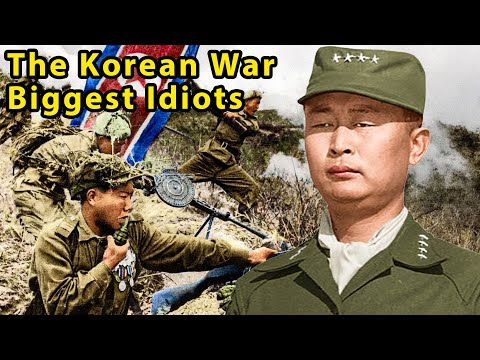
His plan was insultingly simple: cross the 38th parallel, seize Seoul in three days, and unify Korea before the Americans even noticed. On June 25, 1950, his Soviet-built tanks rolled south, blasting through a disorganized South Korean army that barely had working rifles. Within a week, Seoul fell, and Kim began celebrating like the job was done. He posed for photos beside captured artillery and bragged that the imperialist puppets would soon be wiped off the map. For once, he looked like the conqueror he'd always pretended to be.
But the problem with victory parades is that they look identical to retreats in reverse. While Kim's armies pushed toward Busan, Truman's administration decided to intervene. General Douglas MacArthur, the human monument to hubris, launched his amphibious landing at Inchon, cutting off Kim's supply lines in a single stroke. Within days, the invaders became the surrounded. Kim was blindsided. He had gambled everything on the assumption that the United States would not fight over what he considered a regional affair. Instead, the full weight of the UN came crashing down.
As his forces disintegrated, Kim begged Moscow for help. Stalin refused. Mao, well, he hesitated. So Kim did what desperate dictators do best: pretended everything was fine. By October, half his army was dead or missing, and Pyongyang was reduced to rubble. Within 100 days, his glorious invasion had collapsed completely. Kim escaped, captured only by disguising his convoy as refugees, which, in fairness, was the most honest camouflage of his career. His surviving commanders begged him to surrender, but he still insisted that final victory was inevitable. It wasn't.
When the Chinese finally intervened that winter, mostly to keep the Americans off their doorstep, Kim spun the catastrophe as proof of socialist brotherhood. The truth was, his blunder had forced Mao into a war he didn't want and left Korea permanently split down the middle. Stalin's green light had turned out to be a flickering red one, and Kim drove through it at full speed. That failure became the genetic code of North Korean politics, a paranoia so deep it became hereditary. The war that was supposed to make him a unifier instead made him a myth, one that every descendant still has to worship to stay alive. Kim Il Sung mistook Stalin's patience for permission and turned his country into a crater.
The Kremlin's Ill-Fated Chess Game
First, Kim won, then he vanished. And the men who gave him that reckless green light in Moscow somehow managed to be even dumber. They thought they'd start a small fire; instead, they nearly burned down the planet. Picture it: The Kremlin, 1950. Ashtrays overflowing, maps unrolled across a table, the air thick with cigarette smoke and overconfidence. Stalin sat at the head, surrounded by obedient bureaucrats who existed mainly to nod. These men believed they could reshape the world from a conference room, that communism would spread southward into Korea while they denied everything. It was imperialism by proxy, waged from behind the comfort of velvet drapes.
Their logic was beautifully stupid. If North Korea won quickly, the Soviets could claim moral victory without firing a shot. If it failed, they'd blame the Koreans and pretend they'd never heard of them. Stalin even put it in writing: "We will not be drawn indirectly." You can imagine the smugness that line produced. Kim Il Sung begged for the green light. Stalin refused not once, but five separate times before finally relenting with a bored, "Fine, but keep it local." He was convinced the United States wouldn't respond. Truman, he assumed, was too cautious, the United Nations too divided. A regional skirmish, nothing more.
Then the North invaded, and in a matter of days, the global balance of power flipped. The US mobilized. The UN authorized intervention. And within weeks, the entire Western world was marching into Korea. The Soviets had wanted a small spark; they'd lit the Cold War's first wildfire. Still, Stalin insisted on keeping his fingerprints off the evidence. Officially, the Soviet Union wasn't involved. Unofficially, Soviet pilots were flying combat missions over Korea, disguised as Chinese, no less. They listened to American pilots speak in English over the radio, replied in Russian, and pretended the resemblance was a coincidence. Believe it or not, that was the actual plan. Stalin even ordered them to deny their nationality if captured, which is another way of saying lie until you freeze. The Kremlin didn't officially admit any of this until the 1990s.
While his pilots fought and died in secret, Stalin sat back, congratulating himself on his cleverness. The problem was that his cleverness had consequences. Instead of fracturing the West, he united it. NATO grew stronger. American influence ballooned, and the global map he tried to redraw suddenly had sharper edges. Washington now had permanent justification for military presence in Asia, all thanks to Stalin's brilliant idea. Even Mao Zedong, barely finished with his own civil war, saw through the nonsense. He knew a setup when he saw one. Stalin wanted chaos abroad and safety at home, so he pushed China into a war it couldn't afford. When the bodies started piling up, the Kremlin quietly blamed Beijing for the smoke. By the end, the Soviets had achieved the exact opposite of what they'd intended. They wanted chaos abroad; they got NATO at home. The Americans gained allies, the Soviets gained isolation, and the Korean War became a monument to bad geopolitical theater. They tried to play chess with human lives, but as it turned out, they weren't the players at all; they were the board.
The Fallacy of a "Limited War"
Now, let's turn to not a person or a group of people, but an idea, and maybe one of the most idiotic ideas to come out of this whole mess. They called it a limited war, which is a polite way of saying they had no idea what they were doing. The theory was elegant enough for a Washington dinner party: contain communism, avoid escalation, keep the nukes in their silos, and look responsible doing it. Truman promised, "We seek no wider war." You can imagine the self-congratulation that followed.
The problem was Korea never got the memo. Within six months, 20 nations were involved. Two superpowers were playing chicken, and the line between containment and catastrophe was paper thin. Every general thought he understood the rules. MacArthur believed "limited" meant just enough for a parade. Stalin thought it meant "we can fund this bloodbath without admitting it." Mao assumed it meant infinite manpower, zero consequences. Each of them was wrong in a different language.
Beside the speeches and maps, the real arithmetic was obscene. 5 million people died in a war nobody officially declared. Entire cities burned to cinders. Mountain passes became mass graves, and both sides seriously considered dropping atomic bombs weekly. They didn't, not out of restraint, but because no one could agree on who glowed first. In the end, the only thing truly limited was the sanity of the people running it. They tried to fight a world war with one hand tied and used the other to draw the map wrong.
General Walker: Morale vs. Math
General Walton Walker fought the Korean War like a press conference: all sound, no supply. He'd been a bulldog in Europe, a tank commander under Patton, and a man whose motto was "aggression solves everything." When the Korean War began, he saw it as his encore performance, one last chance to prove that audacity could beat arithmetic. You can imagine his confidence, cigar in hand, map spread across the hood of a jeep, telling reporters he'd drive the enemy into the sea. He just didn't realize his own army might get there first.
From the moment North Korean tanks crossed the 38th parallel, Walker's Eighth Army was in freefall, outnumbered, outgunned 10 to 1, and running on fumes. His troops were losing ground by the hour. Ammunition was vanishing faster than reinforcements could arrive. Quartermasters begged for resupply; he ignored them. Instead, he told the press and his men that morale would win the day. Unfortunately, morale doesn't reload.
By July 1950, Walker's "defend at all costs" strategy had turned into a retreat in slow motion. He drew a line around the southeastern tip of Korea and called it the Pusan Perimeter, a patch of land barely big enough to die in. Walker declared, "The line will hold," even as the enemy shelled his positions daily. He told troops to stand or die, even when half of them had nothing left to shoot. Every hill became a grave. Every mile a rumor of survival. His command reports became propaganda disguised as optimism. "We are stable," he told Washington. Well, he wasn't. "The perimeter is strong." Well, it wasn't. Walker was no longer fighting the war; he was fighting the narrative.
Like MacArthur, he mistook bravado for strategy. The only difference was his ended on a Korean highway. When MacArthur's Inchon landing finally turned the tide, Walker took credit for never breaking the line. In truth, he hadn't had the resources to move it. His men held out not because of his genius, but because there was nowhere left to retreat. Then, when the Chinese entered the war that winter, Walker reverted to the same blind optimism that had nearly killed him the first time. He demanded continuous advance operations, even as his tanks ran on half fuel and his soldiers on no rest. His armies were desperate, his army exhausted, and his sense of reality shrinking by the day.
On December 23, 1950, Walker's own momentum caught up with him. Racing between divisions near the front, his jeep collided head-on with a South Korean truck. He was killed instantly, two days before a massive counteroffensive was set to begin. Morale collapsed with him. For all his bluster, Walker's legacy wasn't victory; it was exhaustion. He believed morale could outmuscle math, that speeches could fill supply trucks, and that courage could replace competence. Man, was he wrong.
Truman's Political Paradox: A "Police Action"
And when the propaganda ended, the politics began. Harry Truman started a war he refused to call a war and paid for it in blood and polling numbers. When North Korean tanks stormed across the 38th parallel, Truman went before reporters and declared a "police action." You can imagine the relief in Washington. War sounded costly; police action sounded tidy. The logic was pure politics: act decisive, look calm, and hope nobody notices the bombs. Over the next 10 days, Truman used the phrase 12 times, as if repetition could make it true.
He'd seen what public debate did to presidents in long wars, so he skipped it entirely. No congressional vote, no declaration, no messy headlines. Instead, he leaned on the United Nations, framing the entire operation as international housekeeping. In theory, it was genius: collective action without domestic backlash. In practice, it was chaos wrapped in paperwork. Truman had declared a limited engagement, then mobilized 20 nations to fight it. That's not strategy; that's marketing.
By midsummer, the limited war had turned into a full-scale bloodletting. The US Air Force was incinerating North Korean cities. The Marines were freezing at Chosin Reservoir, and Congress was fuming that the president had dragged the country into a major war without permission. Meanwhile, the public was confused: were their sons fighting communism or just enforcing traffic laws overseas? Inside the White House, the contradictions multiplied. Advisers like Dean Acheson and George Kennan warned him that containment without clear limits would explode. Truman insisted it was working, but it wasn't. The more he tried to restrain the war, the bigger it got.
By the time he tried to reign in MacArthur, the general was running his own foreign policy from Tokyo. When Truman finally fired him, his approval ratings plunged below 25 percent, the lowest of any sitting US president in modern history. The contradiction defined his presidency: a limited war fought with unlimited cost. Over 30,000 Americans killed, 5 million total dead, and no peace treaty, all without a single formal declaration of war.
"He wanted resolve without risk, action without accountability, and history without guilt. What he got instead was a blueprint for every undeclared war to follow."
He'd hoped to contain communism. Instead, he globalized it. The Cold War went from a European standoff to a planetary obsession. Nuclear budgets doubled. NATO became permanent, and Washington learned that you could wage endless war as long as you didn't call it one. A war sold as short-term became an open wound. Truman's genius for plain speaking failed him here. His phrases, "police action," "limited response," "temporary engagement," became synonyms for denial. And the cost wasn't just political; it was moral. Every euphemism made it easier to keep fighting, easier to justify bombing, easier to ignore the dead. He wanted resolve without risk, action without accountability, and history without guilt. What he got instead was a blueprint for every undeclared war to follow.
Mao's Human Wave: Flesh Against Artillery
He called it a police action, but one country's limited war was another's apocalypse. Mao Zedong believed human flesh could beat artillery. He was almost right. When the Americans reached the Yalu River, Mao didn't see an international border; he saw an opportunity to bleed an empire. "We will not tolerate imperialists at our door," he declared, which sounds noble until you realize he was about to send 300,000 men with no winter gear into sub-zero mountains armed with slogans and secondhand rifles. China had just emerged from decades of civil war and famine, but Mao wasn't interested in recovery; he wanted spectacle. He believed ideology was a weapon and suffering was ammunition.
His defense minister, Peng Dehuai, knew better. But in Mao's China, realism was treason. So Peng saluted, said "yes, chairman," and began assembling what was politely called the People's Volunteer Army, because nothing says volunteer like being drafted at gunpoint. The plan was breathtaking in both scope and stupidity: sneak hundreds of thousands of troops across the Yalu at night, strike the Americans by surprise, and drive them south through sheer willpower. For a moment, it worked. UN divisions were ambushed by ghost soldiers who didn't exist. MacArthur was stunned. The world gasped. Mao celebrated.
Then, reality showed up. The Chinese advance outran its supplies within weeks. There was no air cover, no artillery, no logistical support of any kind. Soldiers wore summer uniforms in 40-below weather. Their rifles froze solid. They fought with stolen American weapons and boots ripped from corpses. Peng Dehuai begged Beijing for ammunition and food, warning that "our men are starving, not fighting." Mao sent him slogans about revolutionary spirit. By January 1951, the volunteers had forced the UN back across the 38th parallel. On paper, it looked like victory. In the mountains, it looked like hell.
Nearly a third of Mao's so-called volunteers were dead in under three months. An estimated 100,000 froze to death that winter alone, more than some countries lost in the entire war. Entire divisions disappeared in the snow before ever firing a shot. And yet Mao called it triumph. He told his people China had "stood up to the West," though most of the standing was done by survivors leaning on each other for balance. Even Peng Dehuai, loyal revolutionary and lifelong soldier, privately called the campaign a "war of exhaustion with no clear goal." They even called it the "Long March North," though half of them never came back.
China's intervention saved North Korea, but crippled its own army. Resources that could have modernized the People's Liberation Army were buried under Korean ice. For the next decade, China's military remained frozen in time, a museum of rifles, mules, and misery. Mao and Peng believed that endurance was strategy, but it wasn't. You can win a battle by outlasting your enemy, but if all you have left are corpses, who exactly won?
The Unending "Peace"
The war was ending, but the idiots were not done. They ended a war without ending it, and seven decades later, it's still technically on. By 1953, Korea was a wasteland. Cities leveled, rivers scorched, mountains cratered, millions dead, no side victorious, and every nation desperate to stop the bleeding. So they gathered in Panmunjom, Americans in pressed uniforms, Soviets in smug silence, Chinese in wool coats, and North Koreans glaring at everyone. The goal was simple: stop shooting without admitting failure. How can peace last 70 years without peace?
The deal they signed was not a treaty; it was a ceasefire with paperwork. No reunification, no resolution, just a promise to pause. Both armies stayed exactly where they'd started, separated by a 150-mile scar called the Demilitarized Zone. It was the most militarized demilitarized strip of land in human history, a border so tense that both sides remain on hair-trigger alert for the next 70 years. The irony would be funny if it were not radioactive. The Cold War's grudge between Washington and Beijing became permanent, frozen in barb wire and minefields.
The Korean War has now lasted longer than most countries have existed. Even in 2025, South Korea is still technically at war. And the only living things that thrive in the DMZ today are deer, cranes, and wild boars, because humans can't live there. The ceasefire succeeded where diplomacy failed; it created a nature reserve by accident. Negotiations dragged on for two years while men were still dying at the front. Civilians were bombed during peace talks. Both sides launched offensives while diplomats toasted progress. It was like watching surgeons argue about credit while the patient bled out on the table.
When the ink finally dried, every side declared victory. America said it had contained communism. China called it a people's triumph. North Korea announced "liberation delayed." The war that began with ego ended in paperwork. The architects of the armistice didn't end the Korean War; they just buried it alive. The DMZ became a monument to denial, a shrine to unfinished business. They called it peace, but what they really built was a waiting room for the next war. No victors, just frozen egos.
The Korean War stands as a stark, frigid monument to the sheer, unadulterated folly of powerful men. It's a tale far removed from the tidy narratives of heroism and strategic brilliance often peddled in classrooms. Instead, it's a testament to the fact that history is often less about grand designs and more about the catastrophic consequences of unchecked ego, political maneuvering, and a stubborn refusal to acknowledge reality. The textbook version of history often omits the raw, messy, and frankly idiotic decisions that shaped our world, but here at Nutty History, we understand that those are precisely the stories worth telling. Because the past wasn't just different, it was utterly insane.